Roof Systems
White EPDM Roofing in Spartanburg, SC
White EPDM as a Cooling-Load Alternative to Black Rubber
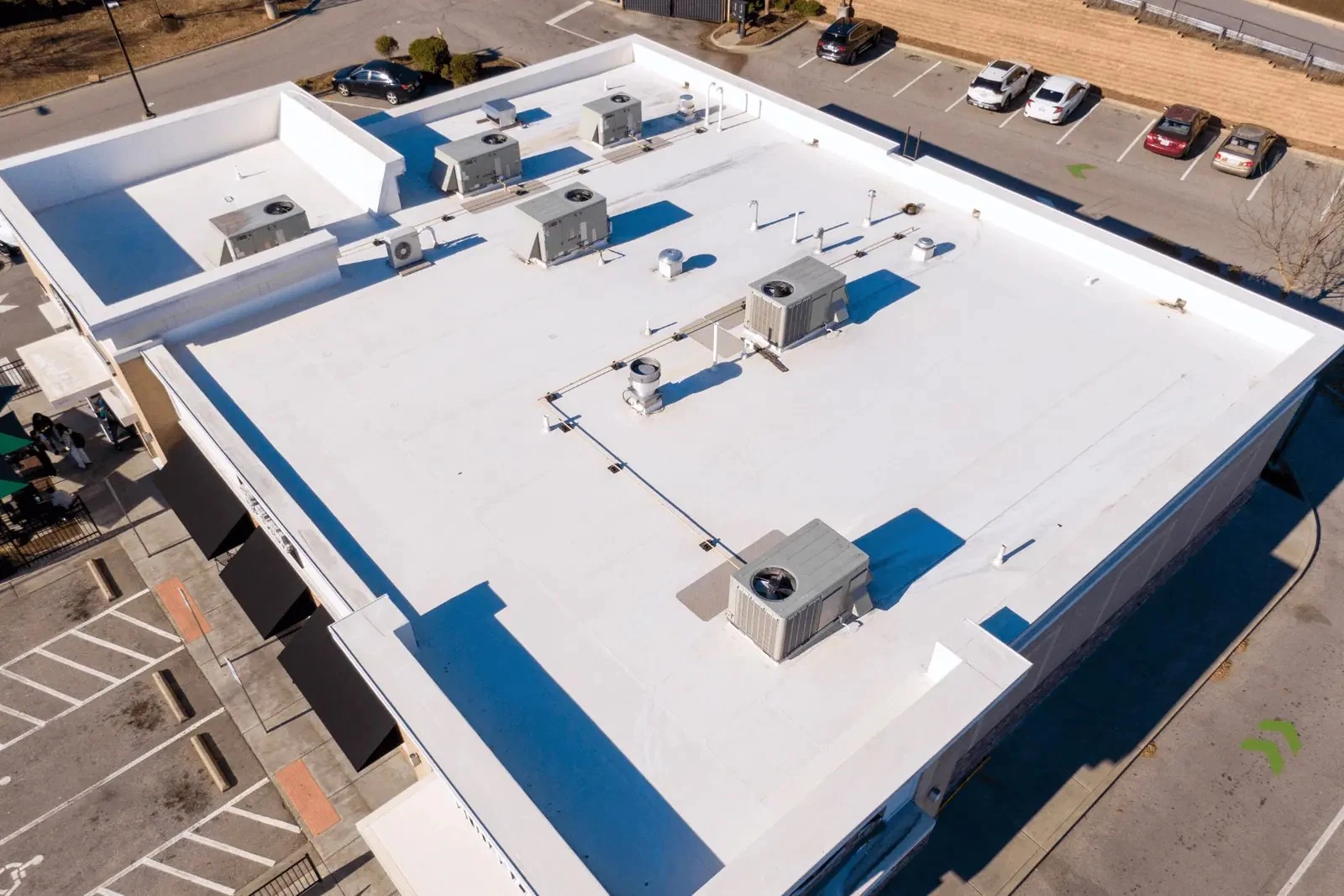
White EPDM gives owners the seam technology and long service history of standard rubber roofing with a reflective surface instead of a dark, heat-absorbing one. It's a narrower product category than black EPDM within most manufacturer lines, and it comes with a few spec differences worth understanding before choosing it for a Spartanburg County reroof.
How White EPDM Differs From Standard EPDM
White EPDM is typically produced as a co-extruded membrane, with a white top ply laminated to a black EPDM base layer, rather than the rubber compound itself being colored white throughout. That construction detail matters for repair work and for how the membrane performs at seams, since the top-ply coating can behave differently than solid-color membranes during welding or seam tape adhesion. We confirm the specific product's construction before quoting, since not every manufacturer's white EPDM uses the same lamination approach. That construction difference also affects how a repair patch needs to be oriented, since a co-extruded membrane has a defined top and bottom face that a solid-color membrane doesn't, and installing a patch upside down defeats the reflective surface at that location even if the seal itself holds.
Reflectivity and Cooling Load
The primary reason owners choose white EPDM over black is reduced rooftop surface temperature and, in turn, lower conducted heat load into the building below. On distribution and manufacturing buildings near I-85 with large uninsulated or minimally insulated roof areas, that reduction can be a meaningful factor in summer cooling costs, particularly on buildings with older rooftop HVAC equipment already working near capacity during Upstate summer heat.
ENERGY STAR and Cool Roof Ratings
Some white EPDM products qualify for ENERGY STAR roof product listings or meet cool roof reflectivity and emissivity thresholds referenced in certain energy codes. We check the current listing status for whichever product we're specifying rather than assuming every white membrane in a manufacturer's catalog carries the same rating, since formulations and ratings do change between product generations.
Seam and Flashing Considerations
Seaming methods for white EPDM generally follow the same tape or liquid-applied systems used on black EPDM, but flashing details sometimes require white-faced flashing accessories to maintain a consistent reflective surface and avoid creating heat-absorbing dark patches at parapets and curbs. We match flashing material color to the field membrane as a standard practice, not an upcharge item, since mismatched flashing is a common cosmetic and performance complaint on white roof systems we're asked to repair.
- Confirm whether the specific white EPDM product is co-extruded or solid-color through the membrane
- Check current ENERGY STAR or cool roof listing status for the exact product line
- Match flashing accessory color to the field membrane at parapets and curbs
- Verify seam tape or seam system compatibility with the white top-ply construction
- Ask about staining and dirt pickup performance over time before committing to white over black
Staining and Long-Term Appearance
White membranes show dirt, algae growth, and staining more visibly than black membranes over time, particularly in humid climates like Upstate South Carolina where organic growth on low-slope roofs is a routine maintenance issue rather than an exception. Reflectivity does decline somewhat as a membrane weathers and picks up surface soiling, which is worth factoring into the expected long-term energy benefit rather than assuming day-one reflectivity numbers hold for the life of the roof. Buildings tucked near tree lines or with adjacent rooftop equipment that sheds debris tend to show more visible soiling than an open, exposed roof, and we point that out during site evaluation so owners aren't surprised when a white roof looks different after a few Upstate summers than it did on installation day.
Warranty and FM/UL Ratings
Warranty structure for white EPDM mirrors black EPDM within the same manufacturer's product family, generally offering material-only and NDL tiers with terms tied to attachment method and inspection requirements. FM 4470 wind uplift and UL 790 fire ratings apply the same way, tested against the specific assembly configuration rather than the membrane color, so switching from black to white on an existing building doesn't change the underlying wind or fire performance requirements for that assembly. We confirm the tested assembly number applies to the white variant specifically rather than assuming a black EPDM assembly rating transfers automatically, since co-extruded construction can occasionally require its own separate listing depending on the manufacturer.
Common Questions on White EPDM
Does white EPDM cost more than black EPDM?
Material cost is typically somewhat higher for white EPDM due to the co-extrusion process, though the gap varies by manufacturer and is often modest relative to total installed roof cost.
Will white EPDM actually lower our cooling bills?
Reflective roofing can reduce cooling load on buildings with significant exposed roof area and older HVAC systems, but the actual savings depend on insulation levels, building use, and equipment efficiency, so we don't promise a specific dollar figure.
Does white EPDM need to be cleaned to maintain reflectivity?
Periodic cleaning can help maintain reflectivity, particularly in humid climates prone to algae growth, though most owners handle this as part of routine roof maintenance rather than a dedicated cleaning program.
Can black EPDM be converted to white with a coating instead of replacement?
A compatible reflective coating can sometimes be applied over sound black EPDM as a lower-cost alternative to full membrane replacement, depending on the existing roof's condition.
Is white EPDM available in the same thicknesses as black EPDM?
Availability varies by manufacturer, and not every thickness offered in black is automatically offered in white, so we confirm current product availability before finalizing a spec.
Ready to review the roof scope?
Request a Roof AssessmentCoverage: Spartanburg and Upstate South Carolina
Building types: Manufacturing, logistics, retail, and institutional
Service: Assessment, repair, replacement, maintenance, and coatings
Systems: TPO, PVC, EPDM, metal, modified bitumen, and coatings
Documentation: Scope, warranty, and closeout records
Response: Spartanburg County and nearby Upstate communities